Storage for DevOps refers to the practices and platforms that let persistent storage be provisioned, configured, and consumed the same way DevOps teams manage everything else: as code, on demand, and without filing a ticket. In a DevOps model built around Kubernetes, storage is expected to behave like any other resource a pipeline or developer can request — declared in a YAML manifest, version-controlled in Git, and available in seconds rather than days.
This is a significant departure from how storage has traditionally been provisioned. Historically, getting a new volume for a database or test environment meant opening a request with the storage or infrastructure team, waiting for manual allocation on a SAN or NAS, and hoping the resulting LUN matched what the application actually needed. That model doesn't scale to the pace of continuous integration and continuous delivery.
Why Storage Matters in DevOps
 DevOps is built on the idea that infrastructure should move at the speed of software: environments are created and destroyed constantly, pipelines run dozens of times a day, and developers expect to provision what they need themselves. Storage is often the last piece of infrastructure to catch up to this model, because persistent data has historically required more careful, manual handling than compute or networking.
When storage doesn't keep pace, it becomes a bottleneck: pipelines wait on manually provisioned test databases, staging environments drift from production because storage configuration wasn't captured as code, and platform teams end up as a manual approval gate rather than an enabler. Modern, Kubernetes-native storage removes that bottleneck by making persistent volumes a self-service, declarative resource like everything else in the stack.
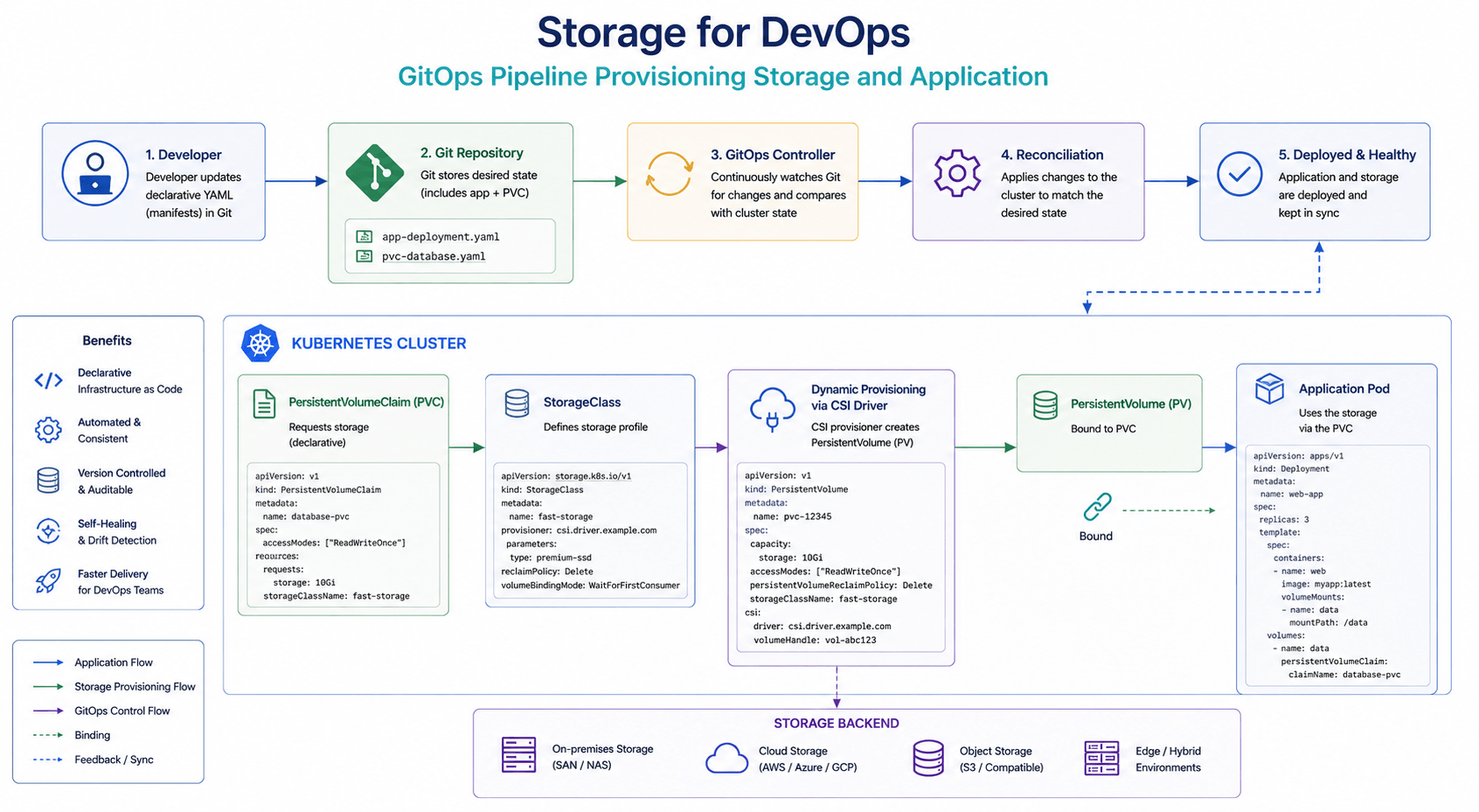
Core Capabilities DevOps Teams Need From Storage
- Declarative, GitOps-compatible provisioning: Storage should be defined in the same YAML manifests and Git repositories as the applications it supports, so a pull request can create, modify, or resize a volume with full audit history.
- Self-service dynamic provisioning: Developers should be able to request a volume through a standard Persistent Volume Claim and Storage Class, without waiting on a manual ticket to a storage administrator.
- Fast ephemeral and persistent volumes for pipelines: CI/CD jobs need storage that spins up quickly for build artifacts and test databases, and tears down cleanly once the job completes.
- Snapshots and clones for test data management: The ability to snapshot a production-like dataset and clone it into a test or staging environment in seconds, rather than restoring from a lengthy backup process.
- Observability integrated into existing tooling: Storage metrics should appear in the same Prometheus and Grafana dashboards DevOps teams already use, instead of a separate storage-only monitoring console.
- API-first, infrastructure-as-code compatibility: Every storage operation, from provisioning to snapshotting to failover, should be scriptable and automatable through Kubernetes APIs and CLI tools.
DevOps Storage Use Cases
- CI/CD pipelines that need fast, ephemeral storage for build artifacts and disposable test databases created and destroyed with every pipeline run.
- Ephemeral test and staging environments cloned from production-like datasets using volume snapshots, then torn down once testing is complete.
- Database-as-code workflows where stateful services, including their storage configuration, are defined and version-controlled in Git and deployed through GitOps tooling.
- Platform engineering and internal developer platforms (IDPs) that offer application teams a self-service storage catalog with predefined Storage Classes for different performance and durability tiers.
- Multi-environment parity, ensuring dev, test, and production clusters use the same declarative storage configuration to reduce environment drift.
DevOps Storage vs. Traditional Storage Provisioning
Traditional provisioning relies on a request-and-wait workflow: an engineer files a ticket, a storage administrator manually allocates a LUN or share on a SAN or NAS, and the resulting volume is attached to a server or VM outside of any version-controlled configuration. This can take anywhere from hours to weeks and rarely leaves an auditable record tied to the application it serves.
DevOps-aligned storage flips this: a developer or pipeline requests a volume through a PVC referencing a predefined Storage Class, Kubernetes provisions it dynamically in seconds, and the entire configuration lives in the same Git repository as the application. Manual, ticket-based storage provisioning is increasingly considered an anti-pattern in Kubernetes-native DevOps environments, not because manual processes are inherently wrong, but because they reintroduce the exact bottleneck DevOps practices are designed to eliminate.
How to Evaluate Storage for DevOps Workflows
- GitOps compatibility: Can storage configuration be expressed declaratively and reconciled automatically by tools such as Argo CD or Flux?
- Self-service provisioning speed: How quickly can a developer or pipeline get a usable volume, from request to ready?
- Snapshot and clone performance: How fast can a realistic dataset be cloned into a new test environment, and how much storage overhead does that require?
- CI/CD tool integration: Does the platform work cleanly with common pipeline tools and Kubernetes operators without custom scripting?
- Observability: Are storage metrics exposed through Prometheus and visualized in the same Grafana dashboards used for applications?
- Licensing model: Predictable, node-based licensing avoids the surprise costs that can come from usage-based or capacity-based pricing as pipeline activity scales.
Frequently Asked Questions About Storage for DevOps
Storage whose configuration — volume size, replication policy, Storage Class — is defined declaratively in YAML manifests stored in Git, and reconciled automatically by a GitOps controller, the same way application deployments are managed.
Platform teams typically expose a small set of predefined Storage Classes as part of a self-service catalog, letting application teams request the right storage tier for their workload without needing deep storage expertise or filing a request.
Yes. A pipeline step can create a Persistent Volume Claim as part of its manifest, have Kubernetes provision the volume dynamically, use it for the duration of the job, and then let Kubernetes reclaim it once the job completes.
Cloud-native storage describes the technical architecture of a Kubernetes-integrated storage platform. Storage for DevOps describes the operational practices, self-service provisioning, GitOps compatibility, snapshot-based test data workflows, built around that architecture to support DevOps and platform engineering teams.
Mature Kubernetes-native storage platforms support volume snapshots that can be cloned into new Persistent Volume Claims within seconds, making it practical to refresh test and staging environments with production-like data on demand.
In Kubernetes-native environments, yes — manual provisioning reintroduces the wait times and approval bottlenecks that DevOps and platform engineering practices are specifically designed to remove. Self-service, declarative provisioning is the preferred approach.
Storage for DevOps From DataCore: Puls8
DataCore Puls8 gives DevOps, SRE, and platform engineering teams Kubernetes-native persistent storage that fits directly into existing pipelines and GitOps workflows. Volumes are provisioned dynamically through standard PVCs and Storage Classes, configuration lives in the same declarative manifests as the rest of the application stack, and storage metrics surface through native Prometheus and Grafana integration alongside everything else the team already monitors.
Puls8 supports automated backup and recovery workflows through Velero, Veeam Kasten, and CloudCasa, and provides snapshot and thin-provisioning capabilities suited to fast test-data cloning. Built on the CNCF open-source project OpenEBS, Puls8 is licensed per Kubernetes node, with no hidden costs tied to pipeline volume or snapshot count, making it straightforward for platform teams to predict costs as CI/CD activity scales.
Named the 2026 Kubernetes Storage Award winner by StorageNewsletter, Puls8 is deployed in production across multi-cluster environments powering databases, AI/ML workloads, observability stacks, and CI/CD pipelines.