Container-native storage is a category of Kubernetes storage in which the storage software itself is packaged and deployed as containers running inside the cluster. Rather than connecting Kubernetes to an external storage array through a CSI driver, container-native storage runs its data plane and control plane as pods on the same nodes as the applications it serves — pooling local node disks, most often NVMe, into a distributed, replicated storage layer that is provisioned and managed entirely through Kubernetes-native APIs.
This architecture is what distinguishes container-native storage from storage that has simply been made compatible with Kubernetes. The storage engine is not bolted on from outside; it is a first-class citizen of the cluster, scheduled, scaled, and upgraded the same way any other containerized workload is.
How Container-Native Storage Works
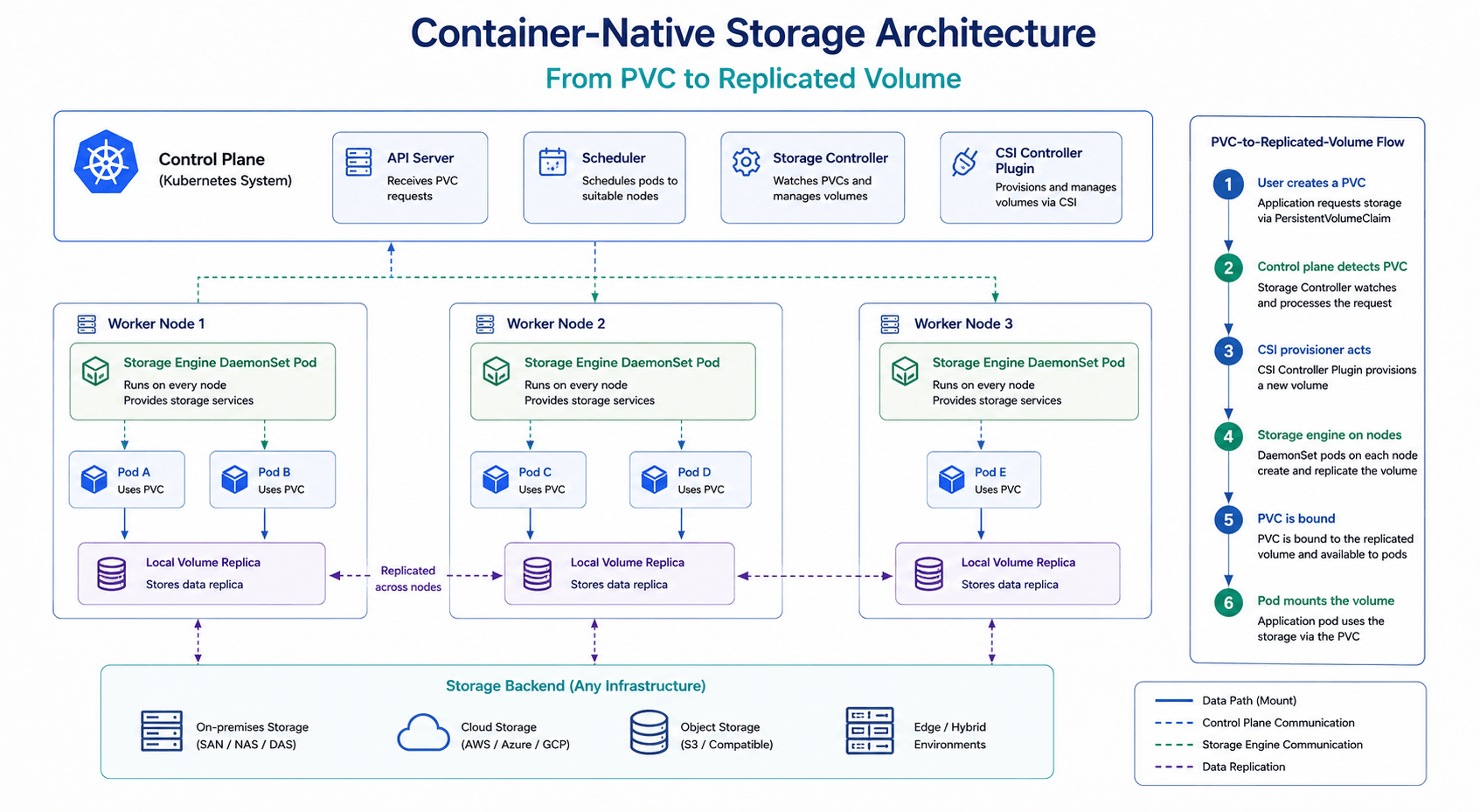
A container-native storage platform typically deploys a small storage engine, often as a DaemonSet, on every node that contributes storage capacity. Each engine claims the node's local disks and exposes them to a control plane that runs as its own set of pods, usually managed through Kubernetes Custom Resource Definitions (CRDs) and operators.
When an application requests a volume through a standard Persistent Volume Claim, the control plane provisions it dynamically, replicates the underlying data across two or more nodes for resilience, and exposes the volume back to the requesting pod over a high-speed protocol such as NVMe-oF. Because everything, storage included, runs as containers under Kubernetes' own scheduler, the storage layer inherits the same self-healing, rolling-upgrade, and declarative-configuration behavior as the rest of the cluster.
Container-Native Storage vs. Cloud-Native Storage vs. Traditional Storage
These terms are related but not identical, and the distinction matters when evaluating platforms.
Traditional SAN/NAS Storage
Storage hardware and software that exist entirely outside the Kubernetes cluster. A CSI driver lets Kubernetes request and mount volumes from the array, but provisioning, scaling, and management still happen through a separate storage management plane, often requiring specialized storage administration skills.
Cloud-Native Storage
A broader category describing any storage solution designed to integrate with Kubernetes as a first-class consumer of its APIs — dynamic provisioning, declarative configuration, and native observability integration. Cloud-native storage can include container-native platforms, but the term is sometimes also applied more loosely to cloud-managed disks that have been adapted with a Kubernetes CSI driver.
Container-Native Storage
The narrower and more specific case: the storage software itself runs as containers inside the cluster and directly consumes local node disks. There is no external array and no separate storage management system to operate. This is the architecture behind DataCore Puls8, which is built and marketed specifically as container-native storage for Kubernetes.
Core Capabilities of Container-Native Storage
- Local disk aggregation: Pools local NVMe, SSD, or other node-attached disks across the cluster into a single logical storage resource, without requiring a dedicated storage appliance.
- Declarative, CRD-based control plane: Volumes, storage pools, and replication policies are defined and managed through Kubernetes Custom Resource Definitions, keeping storage configuration in the same GitOps workflow as application configuration.
- Data replication across nodes: Protects against node and disk failure by synchronously replicating volume data, with automated failover when a node becomes unavailable.
- NVMe-class performance: By reading and writing to local node disks over high-speed protocols, container-native storage avoids the network hop and per-VM throughput caps that limit cloud-managed disks.
- Native observability: Storage metrics flow into the same Prometheus and Grafana stack already used to monitor applications, rather than requiring a separate storage monitoring tool.
- Infrastructure independence: Because it consumes whatever local disks are present on a node, container-native storage runs consistently on-premises, in the public cloud, or at the edge, without depending on a specific cloud provider's storage service.
Benefits of Container-Native Storage
- Eliminates dependency on an external SAN, NAS, or cloud disk service for Kubernetes-hosted stateful workloads.
- Scales storage capacity and performance in lockstep with the cluster simply by adding nodes.
- Reduces operational overhead by managing storage through the same tools, dashboards, and workflows already used for the rest of the cluster.
- Improves cost predictability, since capacity is drawn from local node disks rather than metered cloud storage services.
- Supports hyperconverged Kubernetes deployments where compute and storage share the same nodes, as well as edge and bare-metal clusters with no external storage infrastructure.
Common Use Cases
- Stateful databases and message queues — Running PostgreSQL, MySQL, MongoDB, Kafka, or RabbitMQ directly on Kubernetes, where the container-native storage layer provides the low-latency, replicated volumes these workloads need without an external SAN.
- AI/ML training and inference — Feeding GPU-backed training jobs and inference services with high-throughput, node-local NVMe storage that scales as new nodes are added to the cluster.
- CI/CD pipelines and test environments — Spinning up and tearing down databases and build artifacts on demand, using dynamically provisioned volumes that match the pace of pipeline runs.
- Observability and search stacks — Powering Elasticsearch, the ELK/EFK stack, and Prometheus long-term storage, which need scalable, high-throughput persistent volumes that grow with telemetry data.
- Backup and disaster recovery for containerized applications — Providing the underlying persistent volumes and snapshot capabilities that backup tools such as Velero and Veeam Kasten rely on to protect stateful Kubernetes workloads.
- Edge and distributed Kubernetes deployments — Delivering consistent, self-contained persistent storage at retail, manufacturing, or telecom edge sites, where there's no centralized storage array to connect to.
Evaluating Container-Native Storage Platforms
- Replication and failover behavior: How quickly does the platform detect a node failure, and how is data consistency maintained during failover?
- Performance at scale: Benchmark IOPS and latency as node count and volume count grow, not just in a small test cluster.
- Operator maturity: Evaluate how CRDs, operators, and upgrades are handled, since the storage layer now lives inside the same upgrade cadence as the cluster.
- Backup and DR integration: Confirm compatibility with tools such as Velero and Veeam Kasten for application-consistent backup of containerized, stateful workloads.
- Licensing model: Node-based licensing tends to be more predictable at scale than licensing tied to capacity, IOPS, or volume count.
Frequently Asked Questions About Container-Native Storage
Cloud-native storage is the broader category of any storage solution built to integrate with Kubernetes as a first-class API consumer. Container-native storage is more specific: the storage engine itself is deployed and run as containers inside the cluster, pooling local node disks rather than connecting to external storage.
No. Container-native storage is designed specifically to eliminate that dependency by aggregating local node disks into a distributed storage pool managed entirely by Kubernetes-native controllers.
The storage engine running on each node synchronously replicates volume data to one or more other nodes over the network, so a copy of the data survives even if the original node fails, without needing a shared external array.
Yes. Hyperconverged deployment, where storage and compute share the same nodes, is one of the primary use cases for container-native storage, since it avoids the cost and complexity of a dedicated storage tier.
Mature container-native storage platforms are deployed in production for financial, healthcare, and multi-tenant Kubernetes-as-a-Service environments today. As with any storage decision, evaluate replication, snapshot, backup integration, and vendor support before committing to mission-critical use.
Container-Native Storage From DataCore: Puls8
DataCore Puls8 purpose-built specifically as container-native storage for Kubernetes. It turns local NVMe drives on Kubernetes worker nodes into fast, resilient persistent volumes, with the storage engine and control plane running as containers alongside the workloads they serve. Puls8 delivers dynamic volume provisioning via PVCs and Storage Classes, synchronous replication across nodes, and a centralized declarative control plane for multi-cluster environments.
Puls8 requires no external storage array or separate storage management plane. It integrates natively with Prometheus, Grafana, Veeam Kasten, Velero, and CloudCasa, and runs in hyperconverged, dedicated, on-premises, cloud, or edge configurations, and is licensed per Kubernetes node with no hidden capacity or IOPS limits.
Named the 2026 Kubernetes Storage Award winner by StorageNewsletter, Puls8 is deployed in production across multi-cluster environments powering databases, AI/ML workloads, observability stacks, and CI/CD pipelines.