Hardware Costs Are Rising. Lead Times Are Stretching.
IT leaders today face a compressing squeeze. Hardware costs are up sharply. Lead times that used to run four to six weeks are now stretching to six months or longer. Capital budgets are held tighter than they have been in years. And yet the business still expects more: more performance, more capacity, more resilience. Something has to give — and in most organizations, it is the refresh cycle. The question is what you do with the time that buys you.
Most organizations default to waiting. They defer projects, extend maintenance contracts, and run aging equipment past the point where they are comfortable doing it. There is a better answer — but it requires questioning an assumption that has been baked into enterprise infrastructure thinking for decades.

The Hardware Refresh Assumption
The default assumption in enterprise storage has always been straightforward: when you need more performance or capacity, you buy more hardware. New arrays. New nodes. New everything. That assumption made sense when storage technology was tightly coupled to the hardware it ran on — when you bought a storage system, you were buying a capability stack baked into proprietary firmware and silicon. The intelligence lived in the box.
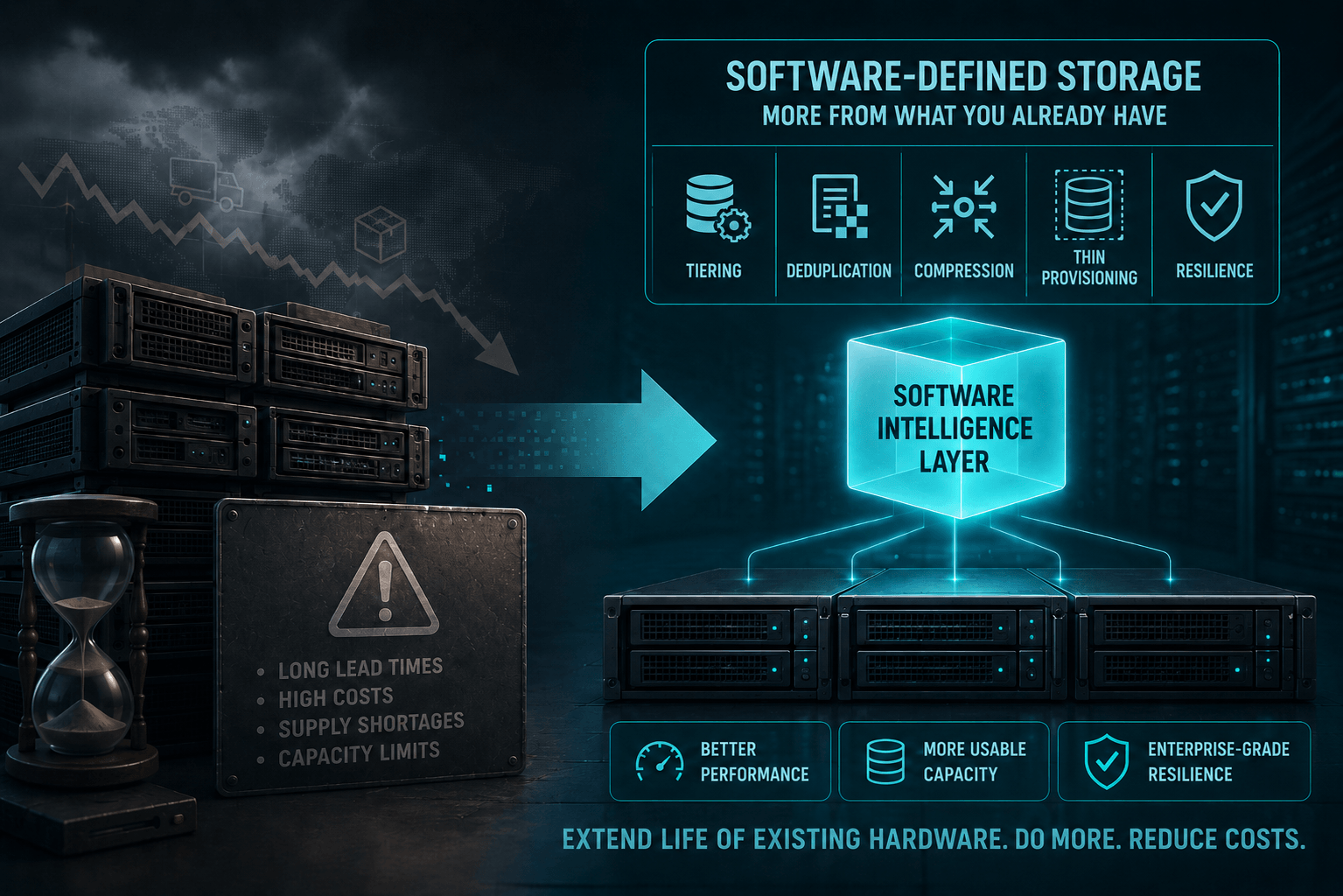
That coupling is breaking. Software-defined storage separates the intelligence — the features, the resilience, the data services — from the physical hardware underneath it. The software runs on commodity x86 servers you already own. The hardware becomes a resource pool. The capability comes from the software layer above it. When you separate those two things, the calculus of the refresh cycle changes entirely.
The Utilization Problem Nobody Talks About
Before asking whether you need more hardware, it is worth asking how well you are using what you already have. Industry surveys consistently show average storage utilization hovering between 40 and 60 percent across enterprise environments. Organizations routinely run out of room — not because the physical capacity is exhausted, but because it is poorly organized, poorly tiered, and never compressed.
The data is there. The drives are there. The servers are there. What is missing is a software layer that can coordinate it intelligently: moving cold data off expensive fast storage, deduplicating redundant blocks, compressing data that compresses well, and allocating capacity on demand rather than reserving it upfront. Without that layer, the natural response to a capacity crunch is to buy more hardware. With it, the first question becomes: how much more can we extract from what we already own?
What Decoupling Storage from Hardware Actually Unlocks
Software-defined storage brings a set of data services that traditional hardware-bound storage either lacks entirely or charges a significant premium for. Adaptive tiering automatically moves data between high-performance and lower-cost storage tiers based on real access patterns; not manual policy rules. Deduplication and compression reduce the physical footprint of data that has already been written. Thin provisioning ensures that capacity is consumed on demand rather than reserved in advance. Intelligent caching maximizes the performance of existing drives without requiring an all-NVMe hardware refresh across the board.
The result is that the same physical hardware pool delivers measurably more usable capacity and better performance than it did before the software layer was introduced. The refresh cycle extends — not because you are ignoring the problem, but because the problem has genuinely been reduced. Hardware that was nearing its useful limit has earned a further two or three years of productive service.
The Economics of the Software Layer
The calculation shifts when you account for the full cost of a hardware refresh: procurement lead times (now six months or more for many server configurations), integration and migration effort, the disruption of moving live workloads to new infrastructure, and the premium pricing driven by constrained supply as AI hyperscaler demand competes with mid-market procurement for the same components.
Against that, the cost of a software-defined storage layer deployed on hardware you already own is straightforward: software licensing, a deployment engagement, and internal testing time. The outcome is a storage environment that is more capable, more resilient, and more efficient than what it replaced, running on the same physical assets. That is not a compromise. It is a better use of existing investment.
There is a second economic argument that is less obvious but equally important. Hardware refreshes are binary: you buy or you don’t. Software capabilities are modular. You can add high availability today, tiering next quarter, and disaster recovery when the budget allows — without making a capital commitment to new hardware each time. The software layer gives you a capability roadmap that the hardware procurement cycle does not.
Resilience Without a Rip-and-Replace
The most significant capability gap in aging storage infrastructure is rarely performance; it is resilience. Older storage environments were not designed with today’s ransomware threat landscape, compliance requirements, or distributed DR expectations in mind. Adding resilience to aging hardware has historically meant replacing it: new arrays with synchronous mirroring, new systems with replication built in.
Software-defined storage inverts this. High availability through synchronous mirroring, asynchronous replication to a secondary site, encryption at rest, immutable recovery points, continuous data protection: these are software capabilities that run on existing commodity hardware. An organization that could not justify the capital outlay for a new enterprise array can deploy enterprise-class resilience on the infrastructure already in the rack.
The Architecture Principle Worth Keeping
This is not an argument for deferring necessary investment indefinitely. Hardware does reach end of life. Physical performance floors do get hit. Some environments genuinely need new hardware, and a software layer will not change that.
The point is narrower: the decision to buy new hardware should be driven by genuine need — not by the assumption that the only way to add capability is to add hardware. When software can deliver that capability on what you already own, the decision becomes easier to make and easier to defend. When the hardware refresh is genuinely necessary, it should happen. When the software alternative closes the gap, it should be the first conversation.
DataCore SANsymphony is built on this principle: a software-defined storage platform that runs on commodity x86 servers — your existing hardware — and brings enterprise-grade data management, availability, and resilience without requiring a replacement cycle. For IT leaders navigating budget pressure, extended lead times, or a refresh that got pushed out for the fourth consecutive quarter, it is the practical path forward.